If you're involved in the international timber business — whether you're producing, buying, or trading — you've felt the ground move under your feet over the past two years. The question is no longer if the market is changing, but whether your commercial setup is built to handle what's coming next.
What's Actually Happening
The global timber trade has been quietly restructured by forces that have nothing to do with wood.
Conflict in the Middle East has disrupted one of Europe's most important demand corridors. Buyers who previously purchased European softwood through established relationships are now navigating sanctions, shipping delays, and payment complications. Some have paused. Others are sourcing from new regions entirely.
At the same time, European demand has been uneven. Construction slowdowns in key markets, shifting monetary policy, and lingering effects of the energy crisis have left many sawmills with capacity they can't fill through their traditional channels.
Meanwhile, logistics costs remain volatile. Container rates fluctuate. Lead times are longer. And the administrative complexity of exporting timber — certificates, contracts, phytosanitary documents, invoicing across currencies — hasn't gotten any easier.
The result? Both sides of the market — producers and buyers — are under pressure to diversify. The old way of doing business, built on personal relationships, regional brokers, and phone calls, still works. But it's no longer enough on its own.
What Diversification Actually Looks Like
For a sawmill or timber producer, diversification means having access to demand from more than one region. It means not relying entirely on a handful of traders or one geographic market. If your biggest buyer pauses orders for three months, you need alternatives — not in theory, but ready to go.
For a buyer or importer, diversification means having verified supply options across multiple producers and countries. It means being able to source quickly when a deal falls through or when a project timeline accelerates. Waiting weeks for quotes through email chains and middlemen isn't just slow — it's a competitive disadvantage.
In both cases, what you need is infrastructure: a structured, always-available channel where supply meets demand, where documentation is handled, and where you can move from inquiry to shipment without reinventing the process every time.
Where ed-Timber Fits
This is exactly what we've been building since 2021. ed-Timber is a digital timber trading platform that connects European producers directly with buyers worldwide. Over 450 businesses are now registered on the platform — sawmills, traders, and buyers spanning Europe, the Middle East, North Africa, Asia, and beyond.
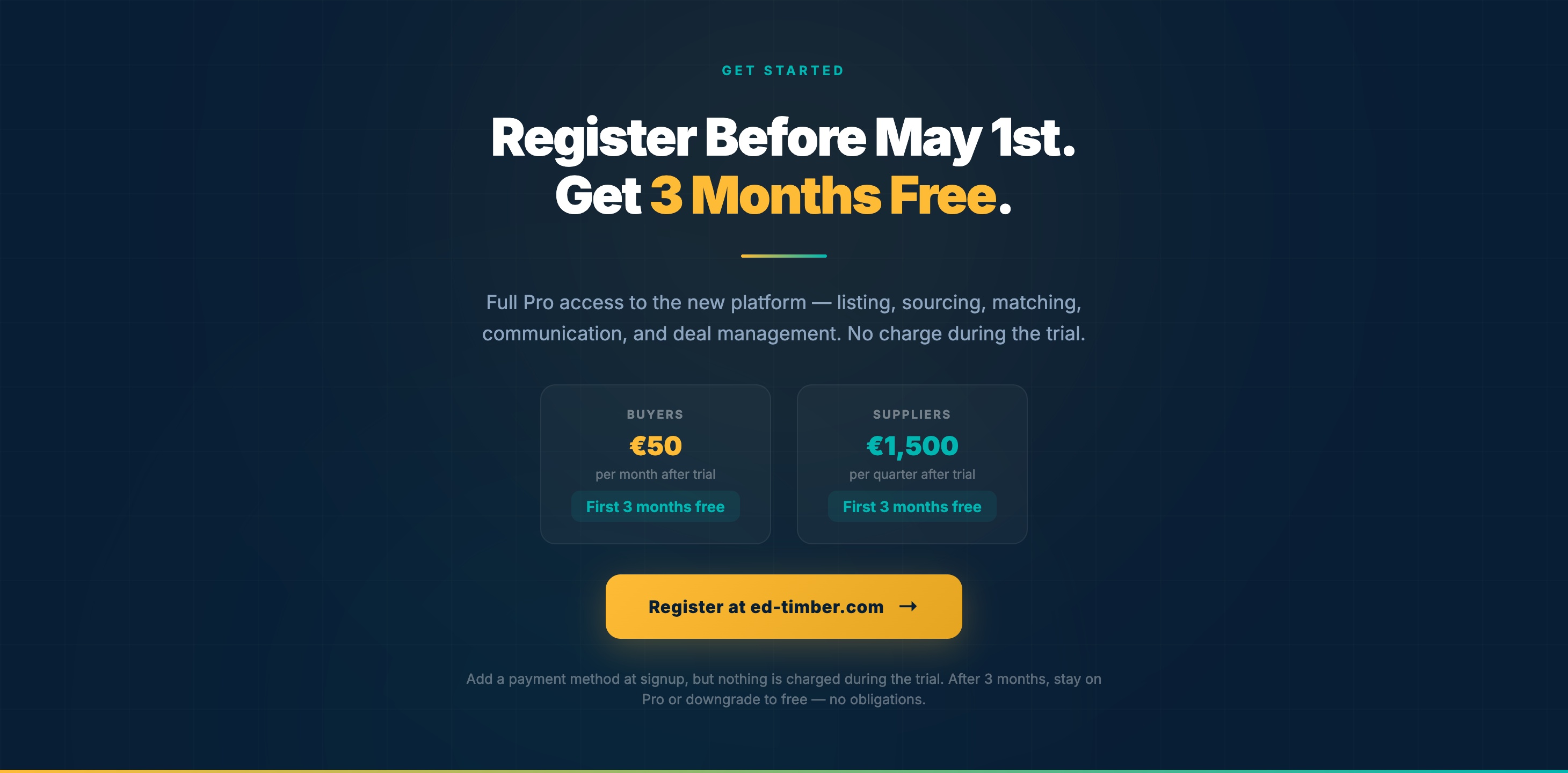
On May 1st, 2026, we're launching a major platform upgrade — rebuilt tools for listing, sourcing, matching, communication, and deal management. And for anyone who registers before that date, we're offering three months of full access, completely free.
We're not claiming to replace your existing sales channels. What we are offering is an additional one — digital, structured, and connected to a growing international network.
ed-Timber exists so that a sawmill in Europe doesn't need to rely on one or two traders to reach the world. And so that a buyer anywhere — whether in North Africa, the Gulf, Turkey, South Asia, or beyond — doesn't need to fly to Europe to find a reliable source of spruce or pine.
The platform is the bridge. And it's about to get significantly better.
The Practical Case
Consider a mid-sized sawmill in Austria producing KD spruce. Their core markets are Germany and Italy. Business is fine, but margins are tight and demand fluctuates seasonally. Through ed-Timber, they gain visibility to buyers from Morocco to Egypt, from Saudi Arabia up to Turkey, across Asia, and beyond — markets they'd never have reached through their existing network. No cold-calling. No trade fairs. Just a profile, a listing, and a platform that connects them to demand worldwide.
Now consider a buyer in North Africa sourcing construction-grade timber for a housing project. They need reliable supply, competitive pricing, and documentation they can trust. Instead of contacting sawmills one by one across three countries, they submit a single request on ed-Timber and receive verified quotes within days.
Both scenarios are happening on the platform today. The upgrade on May 1st makes them faster, smoother, and more scalable.
What to Do
If you're a timber professional — producer, buyer, or trader — and you don't yet have a digital trading channel, the cost of waiting is going up. Markets don't wait for you to build relationships manually.
Register at ed-timber.com before May 1st and lock in three months of free Pro access to the new platform. You'll add a payment method at signup, but nothing is charged during the trial. After three months, you choose: stay on Pro (starting from €50/month for buyers, €1,500/quarter for suppliers) or downgrade to limited free access — no obligations either way.
The worst-case scenario is that you try it and decide it's not for you. The best case is that you find your next buyer, your next supplier, or your next market — without leaving your desk.
Follow us on LinkedIn:
linkedin.com/company/ed-timber
That's where all our updates, insights, and platform news will live. No noise, just what matters.